

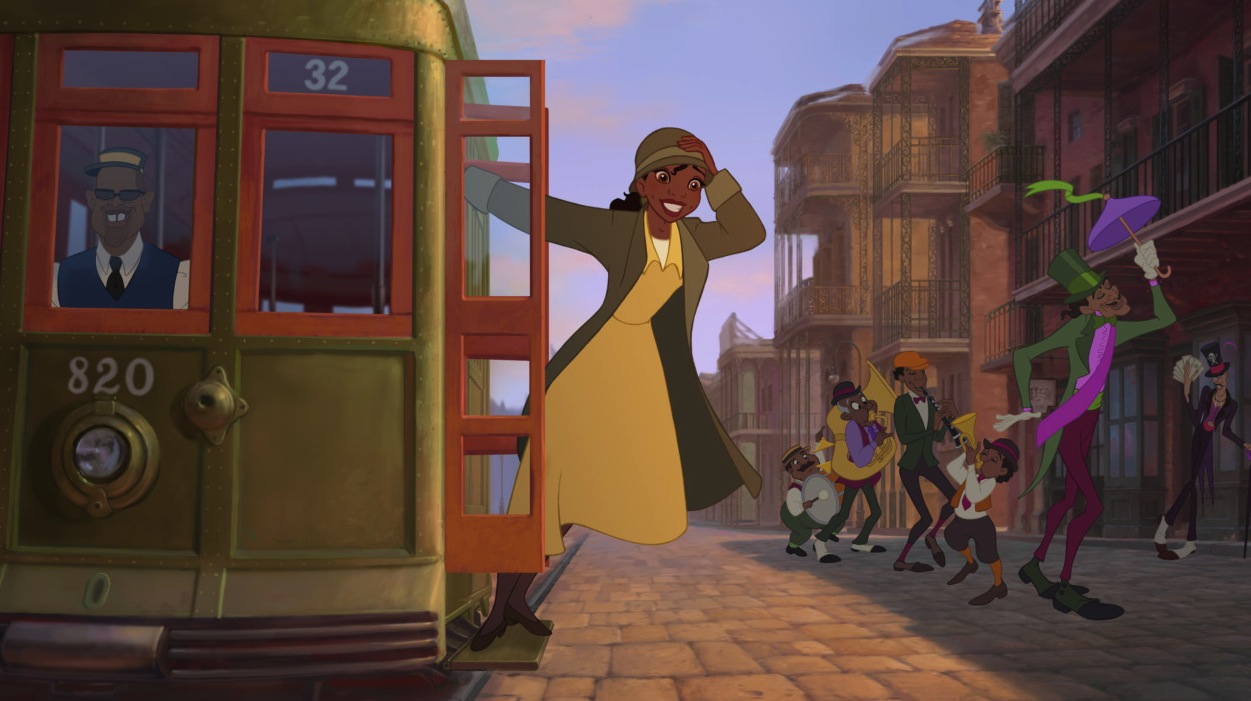
As a return to the style of storytelling that made Walt Disney Animation a titan of mythmaking in the 20th century, putting a modern gloss on age-old fairy tales, “The Princess and the Frog” is on par with some of the greats, with sumptuous visuals, endearing characters that are easy to fall in love with, and music that ear-worms into your soul. The long-awaited resurrection of the hand-drawn style from the historic studio, which had fallen prey to the doldrums of computer-animated mundanity in the mid-aughts, the film was heralded on release as not just a celebration of the art form but a celebration for the first African American Disney Princess, Tiana. The film is lush and sweeping in its presentation of New Orleans, and by extension Mardi Gras, with directors John Musker and Rob Clements (Directors of “The Little Mermaid”, “Aladdin”, and “Moana”) transmuting the iconography of the city and the season into classic fairy tale archetypes of benevolent kings, wicked sorcerers, and chatty animal side kicks. The shape of the film is familiar and comforting and easy to swallow, a chicken and sausage gumbo stewed with care and the faintest hint of seasoning; though, as Tiana knows well, sometimes even the most well-regarded, focus group-tested, and well-intentioned dish would be something special if only it had a little extra hit of Tabasco.
The film opens on the cusp of Mardi Gras eve as Tiana is hard at work saving the last bit of cash needed to build the restaurant she and her deceased father have forever dreamed of, a place where the community can come together and find solace in the food they share. Concurrently, Prince Naveen of Maldonia arrives via river boat, with his bumbling British attache Lawrence in tow, a free-wheeling dolt of a handsome rich boy who is too distracted by rampant jazz and street buskers to focus on the task of finding a rich wife to replenish his depleted cash flow. Thankfully for him, Tiana’s rich, spoiled, but soft-hearted friend Lottie is manically anticipating the Prince’s arrival; ready to snatch him out of the dating pool and secure her lifelong dream of becoming a real-life princess, not just Carnival one. Taking as literal the advice that the way to a man’s heart is through his stomach, Lottie coopts a fat stack of cash from her doting father, Big Daddy La Bouff, the wealthiest man in town and the “King of Mardi Gras” for the fifth year in a row, and hires Tiana to make a batch of beignets for the evening’s masquerade ball to help seal the matrimonial deal. Meanwhile, Dr. Facillier, a voodoo shadow man, corners and coerces Naveen into his clutches, using demonic forces to turn him into a frog as part of an intricate, metaphysical plan to lay claim to all of New Orleans. At the masquerade ball that night, Tiana is devastated to learn that the two brothers who own her beloved sugar mill have, allegedly, received a higher offer; though it’s clear the two men, dressed fittingly as the head and tail of a jackass, felt uncomfortable selling their property to someone of Tiana’s “background”. Bereft and without a place to turn, Tiana happens upon Naveen, now a talking frog who, taking inspiration from the classic story of “The Frog Prince”, promises to fund her restaurant dreams if she were to kiss him and turn him human once again. They kiss, but instead of turning Naveen human, Tiana is turned into a frog, spurring the pair on a journey into the bayou to find someone who could reverse the curse before the final stroke of midnight on Mardi Gras, when the Shadow Man’s machinations are set to take effect.
“Princess and the Frog” wears New Orleans draped around itself like a rented tuxedo for a Carnival ball, the kind that fits well enough but not as snugly as something custom-made would do. While every creative force behind the project is masterful in its own way, there’s a combination of ingredients that just feels borderline antiseptic, too bland by half. There’s something quaint and classic about the Randy Newman score that helps the movie feel as important as Disney intended, but something is lost in the incongruity of tones, with stirring strings that evoke “Toy Story” where you imagine horns to be wailing. There’s a magic in the city’s music that does not need reinterpretation, a spell summoned from generations spent finding meaning and solace in the sequential sounds of suffering and decadence. Having a white man, even one with deep ties to New Orleans, be the composer for a story set amid such a fruitful musical legacy about an African American “princess” is certainly less than ideal, along with the overall dumbing down of almost every facet of the culture and history of the city. Tiana is a distinct and heroic character, yet it’s clear that Musker and Clements have little interest in pinpointing the complicated, brutal, and oppressive societal factors that led to her need to “dig a little deeper”. Class matters when talking about New Orleans, as does race. “The Princess and the Frog” is willing to contend with the former somewhat, while merely hinting at the latter. Take Lottie, for example, a charming debutante with a heart of gold, who is also an anachronism; the warm and kind rich girl obsessed with becoming a princess but willing to drop that crusade at a moment’s notice to help her much more impoverished friend. She makes for a memorable and lovable character, but is perhaps the most fanciful creation in a film where living shadows stalkthe Quarter and a firefly falls in love with a wishing star. Disney is notorious for sanding down the rough edges of human nature, especially in the South, casting the ruling class in rose colored hues that uphold inherent biases without acknowledging the harm in their perpetuation. In the true New Orleans, it’s not a voodoo man who will destroy your life, but the Big Daddies of the world, who are often more ruthless and less John Goodman-like than the movie would have you believe.
The film, crafted as the crown jewel of a new Disney animation renaissance, wishes to have its king cake and eat it too, framing Mardi Gras as a fanciful fantasia of good-natured bacchanalia without the historical bias and degradation ever present behind the traditional dead-eyed masks of parade-mounted krewes, the modern gentry bequeathing their plastic baubles to the uncouth masses scrabbling far below. For Tiana, life in New Orleans is difficult but equitable and honest, a meritocracy where dreams are achievable if you want them enough and are willing to do the work, which makes one wonder how Big Daddy made his fortune. Perhaps he was one of the sugar barons or the cotton kings, growled of with reverence by Dr. John in the film’s opening musical number, “Down In New Orleans”. “Rich people, poor people, all got dreams”, he sings, “Dreams do come true in New Orleans”. If only it were that easy. While the story allows that Tiana needs to give herself a break and smell the magnolias, it never dissects how the systemic forces acting against her are decidedly more insidious than those of any voodoo power from “the other side”. There are hints throughout the film at the experience of being a Black family in New Orleans near the turn of the century: the debilitating weariness in Tiana’s father, the row of lovingly cared-for yet decidedly modest shotgun homes where they live, and the fact that Tiana and her mother sit in the back rows of the streetcar. These real-world socio-economic factors are presented as you would the plight of a peasant in a fairy tale, a hopeful dreamer who grew up in the slums of the kingdom and hopes to one day be a part of something greater. That framing, which works wonders for a princess story, feels simplistic and pat when staging a story in a real place where real people have lived, died, struggled, and triumphed against forces much more oppressive and insidious than any beast of fantasy.
Despite the film’s general glazing over of real-world evils, “The Princess and the Frog” is easy to enjoy and hard not to begin to appreciate upon rewatch. Its grasp upon the unique machinations of the city is tenuous at best, and its presentation of Carnival is about as authentic gumbo as scooped from a soup can instead of a lovingly bubbling pot, with key plot points hinging on a parade somehow taking place in front of St. Louis Cathedral near midnight on Mardi Gras night. Perhaps the world thinks midnight Mardi Gras parades are a thing, though the real ones know that by 3 pm on Fat Tuesday, everyone is back home, pleasantly hungover with a box of half-eaten Popeyes in their laps. There is a love for the city within the text without any inherent understanding, a common failing of films made by those who are not from here, though Musker and Clements get several points with this joke when Tiana and Naveen meet the Cajun firefly Ray:
Ray: “I’m a Cajun, bro. Born and bred in the bayou! Y’all not from ’round here, are ya?”
Prince Naveen: “Actually, we are from a place far, far away from this world.”
Ray: “Go to bed! Y’all from Shreveport?”
But it’s apparent that the hearts of filmmakers and collaboratare ors clearly in the right place, if not their cultural understanding. So far as depictions of Mardi Gras go, at least it gets the bright spots right, though the total of a city and its people, its magic both good and bad, deserves to be seen for everything it is, was, and could be. That’s the dream, one that perhaps must be done for ourselves here at home, where wishing stars and fireflies dance along the moonlit sky, down here in New Orleans.
You can rent a copy of “The Princess and the Frog” and a wide selection of other New Orleans/Louisiana-set films from Future Shock Video.
For more movie recommendations, and to see all the films in the “Mardi Gras At The Movies” series, CLICK here to follow me on Letterboxd.
You’ll be glad you did.
